

You didn’t lose them on the call.
You lost them in the three days after, when the next step lived in your head instead of on a card with a date.
I’ve watched this for eighteen years. Good conversation. Real interest. Then Thursday they tell you they already signed with someone else.

The board. Owner, stage, and a dated next step on the same card.
The call was never the leak
You remember the meeting. You don’t remember the thing that would have kept it moving: the budget cycle, the person who actually signs, the question you promised to come back on.
That detail was the deal. And it was sitting in an inbox, a WhatsApp thread, and a notebook. Nowhere a system could see it.
A buyer is busy. Your proposal is under forty other emails. One follow-up is a coin flip. A dated next step, done on purpose, is a system. A person running on memory cannot be a system.

Leads don’t ghost. Follow-ups do.
Most teams that “have a CRM” have a filing cabinet. Names go in. Nothing comes out. Nobody gets told to do anything on Friday.
The leak is not capture. The leak is the handoff: no owner, no stage anyone trusts, no next action with a day on it.

Every conversation on one timeline. Email, WhatsApp, SMS, calls.
What actually keeps a lead
Every deal that closes after a good call moves through the same sequence. Miss one and it stalls.
Know their pain in their words. Not your pitch. If you can’t say it back the way they said it, you haven’t earned the next meeting.
Name the real problem, not the symptom. “We need a CRM” is a symptom. “Three people quoted the same job and nobody knows which number went out ”is the pain.
Put an owner, a stage, and a date on the same card before you stand up. A stage nobody trusts is worse than no stage.
Follow up on a system, not a feeling. That’s the first thing that breaks when it depends on memory.
Present the solution and the number together. Two slow steps is two chances to lose them.
Answer the question behind the question. “How long does this take” usually means “how badly will this disrupt my team.”
Show the pain solved, and what it unlocks. Not features.
Where the system earns its place
The useful version is quiet. The call ends and the notes are already on the timeline. The next action is already drafted. The deal has already moved.
You didn’t type a novel. You didn’t remember a date. The system did what a system is for, and you spent the attention on the customer.
That’s the bar. Anything less is still a filing cabinet.
The honest summary
Notebooks aren’t the problem. Depending on them is.
Every lead that “went quiet” was a follow-up that didn’t happen, a pain point half-understood, or a detail that lived in someone’s head and then didn’t.
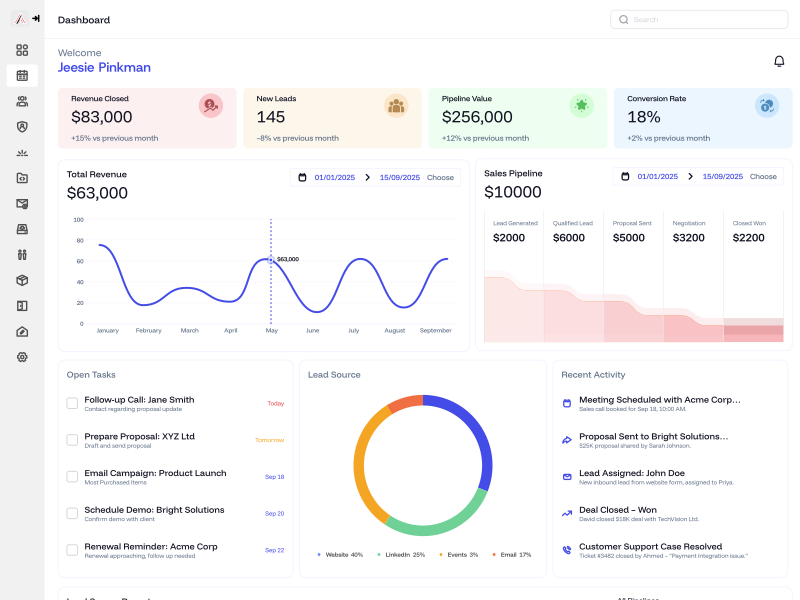
Arches CRM is built around this. Leads, pipeline, follow-up, and every conversation across email, WhatsApp, SMS and calls on one customer timeline.
Seven days. No credit card.
Start the 7-day trial → https://bit.ly/4hhBJDK
Want twenty minutes instead? Book a demo →
Daks
